

AI is known for using fancy words. Artificial intelligence is becoming more famous as it grows.
AI startups have raised nearly $1 billion, the highest in five years. However, the AI craze is following a familiar bubble pattern. It’s generating revenue, but not profit. For economists, this is a unique phenomenon. Economists Brand Goldfarb and David explain this in their book, ‘Bubbles and Crashes,’ which informs today’s discussion. The book, published three years ago, outlines four main signals of technological bubbles: uncertainty, pure play, no-nonsense investors, and narrative fever. When these align, innovation becomes speculation.
These same factors contributed to the dot-com bubble in the late 1990s, and they also contributed to
If you look at it today and compare it to the AI landscape, AI is also becoming a textbook example of a bubble. First of all, let’s talk about the uncertainty.
The biggest problem with AI in the world is that no one has yet decided on its viable business model. Think about it until 2022. They have invested billions of dollars in players like Opric Gemini, but despite these investments, they do not have a clear idea of how to withdraw money from them and generate a profit.
Inference computing costs are so high that even a popular product like ChatGPT, if you look at every individual query that you and I ask, the company is losing money and is not earning a profit on your and my queries.
The second and most dangerous factor is pure place, i.e., startups whose entire fortune is based on one technology. In this case, AI Artificial Intelligence, in the first quarter of 2020, about 60 percent of the total global venture capital funding went to AI startups alone.
Now what are these startups doing with all this money?
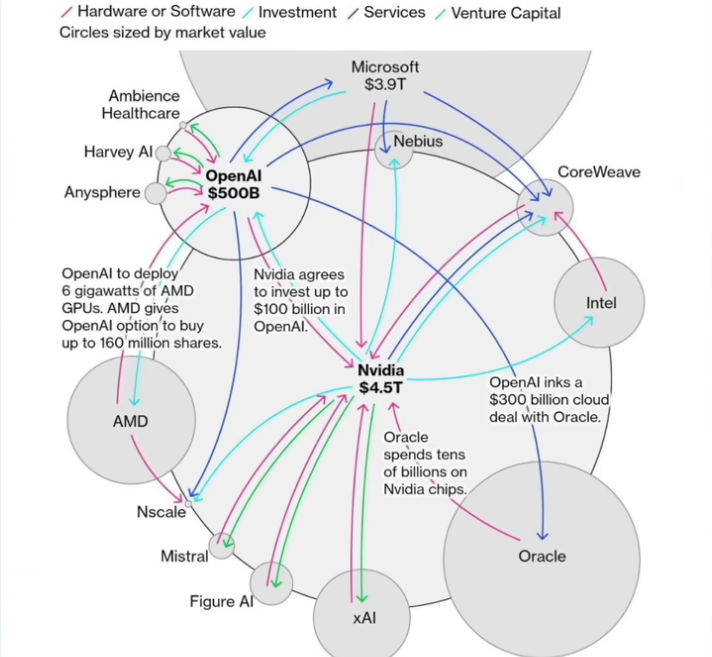
A significant portion of this money is being invested in companies, creating a circular loop where money circulates and inflates the AI bubble further. Let’s illustrate this with a chart that is currently going viral on the internet, revealing the truth about the AI boom. So it is viral.
This is good. Open AI. Yes, it has earned $12 billion. It has its own revenue. Remember, we are not talking about profit; I am just talking about returns because overall, despite all this craze and madness, this company is still running at a loss, but OpenAI has become a $500 billion company today. How come so much money is being invested in this loss-making company? More importantly, who are these people? Where do they come from? You will also find the answer to this question hidden on this chart. First, let’s look at the biggest player in this chart .NVIDIA is going to invest $100 billion in OpenAI alone.
Why is it that Nvidia loves OpenAI so much?
In fact, over the last five years, Nvidia’s net worth has increased by more than 1300 percent, as the company produces the world’s best chips, which drive the entire AI industry. Apart from AI, Nvidia’s chips and its hardware are in great demand, but after the advent of AI, the demand for it has taken off. OpenAI and all AI and AI-related companies worldwide require AMD chips to train their large language models. Sometimes this training is conducted directly on-site, such as in their own data centers. However, most AI companies rely on data centers from companies like CoreView and Oracle to train their models. Similarly, alongside AI companies, these data centers are also very busy with these media chips.
